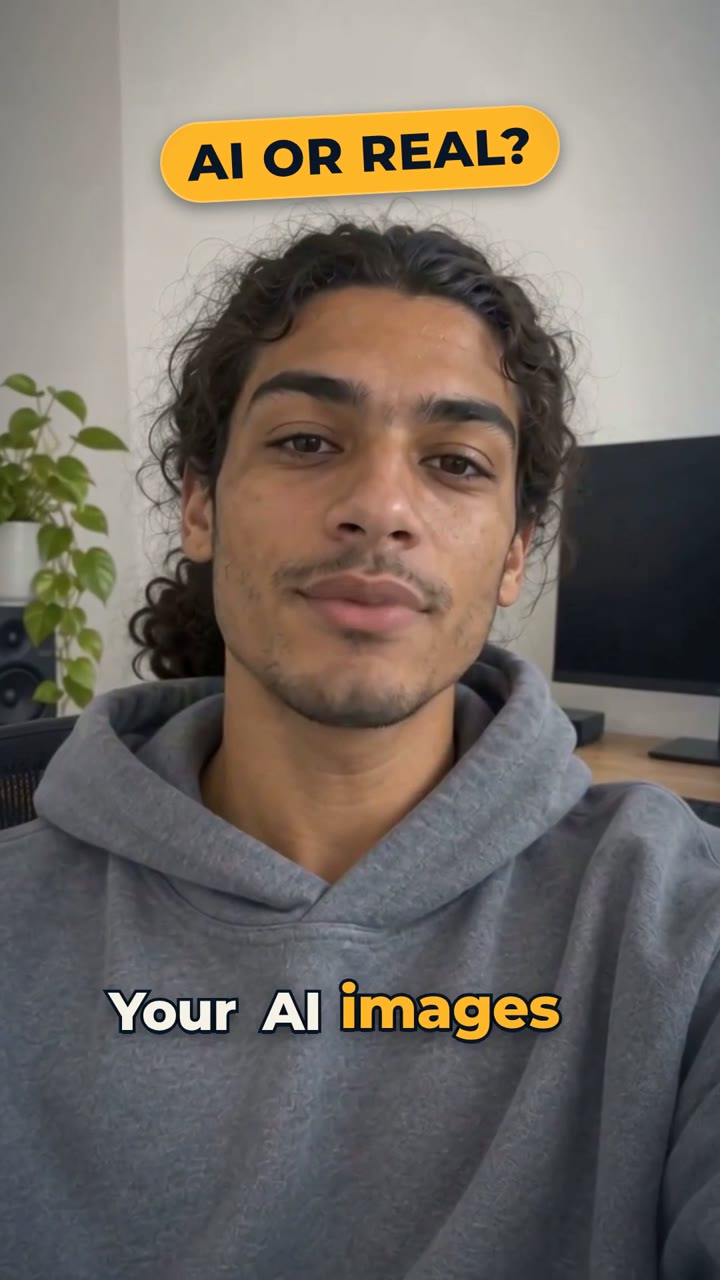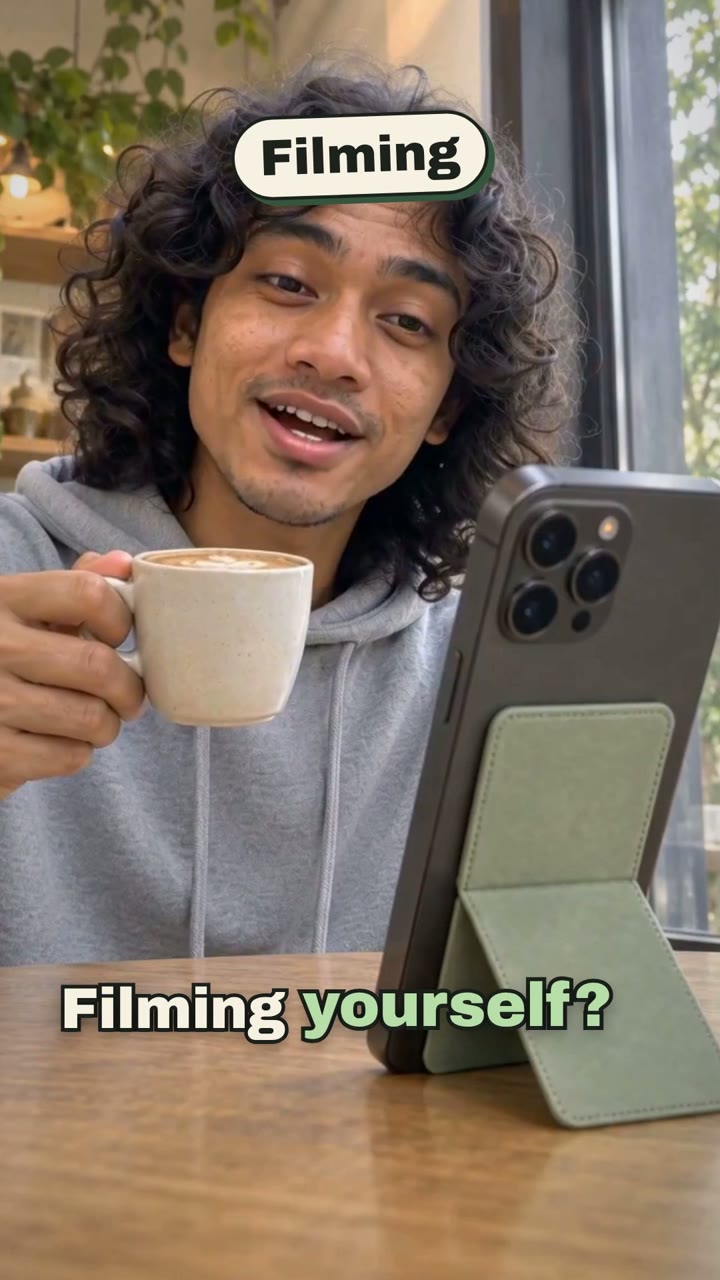
What an AI UGC video generator should actually produce
UGC-style ads look like a person talking to the camera rather than a polished commercial. Making that with AI takes more than a talking head. It needs a hook at the start, a script that sounds spoken rather than written, a presenter who acts the lines, readable captions, often music, and a cut that keeps moving. If any of those is missing from an AI UGC video, you end up in an editing app finishing the job yourself.
ReelHatch is built around the whole job. A prompt goes in, a finished MP4 comes out, and the decisions in between are made by a director agent that works the way a small video team would. You never touch a timeline.
Create UGC videos with AI: what the director does
- The research. It reads your prompt and every page you link, searches the web when it needs to, and saves your real product images and screenshots.
- The script. It finds the angle (the offer, the audience, the claims you can back up, the call to action and the vibe) and writes a spoken script with a hook for the first second.
- Casting and performance. It casts a new AI presenter who suits the audience, or uses the person in your photo, and has them act: holding, using and showing your product between lip-synced lines.
- The voice. One voice designed for this presenter, in English or one of seven other languages, with the accent and energy you ask for.
- The scenes and graphics. Moving shots, your attached pictures, and graphics built for this ad: phone screens, counters, price tags, split screens.
- Captions and music. Word-by-word captions are burned in and a track is composed for the mood; you can switch either off in the composer.
- The cut. Every cut pinned to a word or a beat, checked frame by frame, and delivered as a vertical ad at 1080x1920.
What you get
- A finished MP4 at 1080x1920 and 30 fps (H.264), ready for TikTok, Instagram Reels and YouTube Shorts.
- Any length from 10 to 60 seconds. The length is a target: the director cuts to the script, so a 15-second ad may come out a little shorter or longer.
- Word-by-word captions burned in unless you switch them off, so each line can be read as well as heard.
- Production notes: the script and the choices behind the cut, so you can prompt the next one better.
- Commercial use of every video you make, including paid ads.
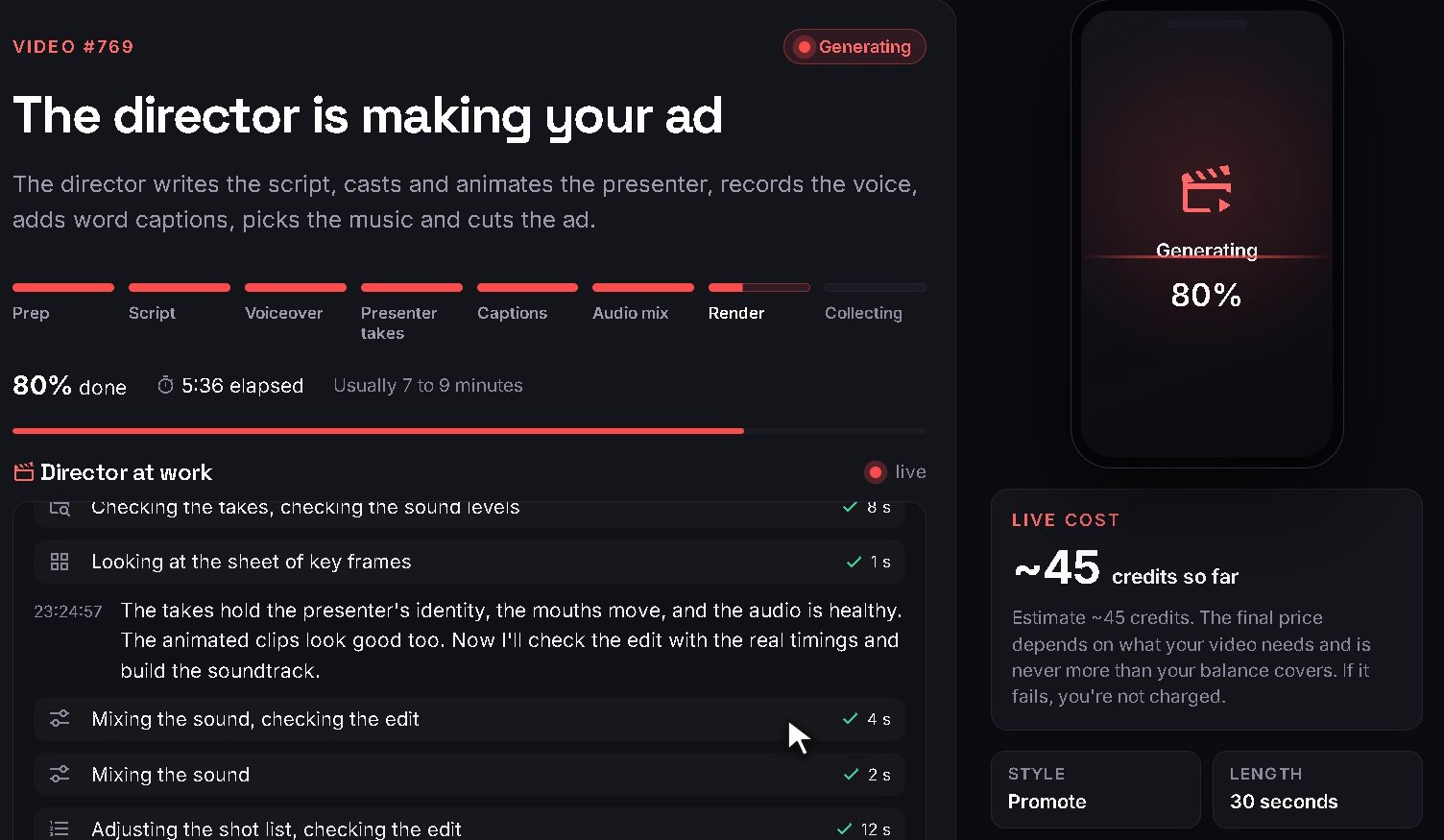
Most runs take 7 to 9 minutes. You can watch the director's notes live or close the tab: an email arrives when the video is ready.
What it costs
Each video is priced by what it takes to make: its length, the shots, the voice and the music. You pay in credits worth $0.10 each, so a short ad without music costs less than a long one with music. These are typical figures from the same price list the app uses:
| Length | With music | Without music |
|---|---|---|
| 10 seconds | ~25 credits ($2.50) | ~23 credits ($2.30) |
| 15 seconds | ~30 credits ($3.00) | ~28 credits ($2.80) |
| 30 seconds | ~45 credits ($4.50) | ~43 credits ($4.30) |
| 60 seconds | ~59 credits ($5.90) | ~57 credits ($5.70) |
A video that fails is never charged. A finished video is charged even if it is not what you pictured, because every run spends real production money; within 72 hours you can revise it for a few credits or make another take. The full rules are on the refunds and charges page, and the plans are on the pricing section.
An AI UGC video maker, or an avatar tool?
Not every AI UGC generator does the same job. Plenty of tools can put an AI presenter in front of a script, and some can draft that script for you too. What differs is how much of the finished ad is left to you and how you pay for it. Here is a script-first workflow, where a presenter reads a script you wrote or approved, next to ReelHatch's prompt-first one:
| Script-first: you bring the script | ReelHatch: you bring a prompt | |
|---|---|---|
| You start with | A script, written by you or drafted by the tool and approved by you | A prompt, as many links as you like, or your own pictures |
| The presenter | Picked from the tool's avatar library | Cast for your ad, or the person in your photo |
| Voice and music | Picked from a library, or a clone of a recording | A voice designed and a track composed for this ad |
| You get | A presenter reading that script; captions, music and the edit vary by tool | A finished ad: hook, presenter, voice, optional captions and music, and the cut |
| Price | Varies by tool and plan | Priced per video by what it needs, shown before you generate |
| When it fails | Depends on the tool | Never charged |
Presenter-led ads are one kind of ad ReelHatch makes. The AI video ad generator page shows the other three, with a real example of each.
How to pick the best AI UGC video generator for you
Whatever AI UGC creator or AI UGC video maker you try, four questions sort them quickly:
- Does it make the whole ad? If you still need to write the script, add captions and cut it, count that time in the price.
- Is anything in it recycled? A stock avatar, a stock voice and a stock track can turn up in a hundred other brands' ads. In ReelHatch the presenter, the voice, the music and the graphics are made for your ad.
- Do you pay for failures? Generation fails sometimes. With ReelHatch a failed video costs nothing.
- Can you see the price first? ReelHatch's composer shows the estimate for your length and options before you sign up, and the confirm step repeats it before anything starts.
Keep AI UGC ads honest
An AI presenter can show, explain and demonstrate your product. It must not pose as a customer or report results it never had, because that is a fake testimonial. In the US, the FTC's rule on consumer reviews and testimonials (16 CFR Part 465, announced in August 2024) bans testimonials that misrepresent that they come from someone who does not exist, such as AI-generated ones, or from someone with no actual experience of the product. Our terms rule it out too, and TikTok makes an AI-generated content disclaimer mandatory on ads like these (see the AI TikTok ad maker page). So prompt the presenter as a host: "the presenter shows the dropper and names two facts", not "the presenter says it cleared her skin".
Source: FTC, final rule banning fake reviews and testimonials (August 14, 2024). This is general information, not legal advice.
Pro tip: every run is a fresh take, and no ad wins every audience. Make three takes of your best angle, test them on a small budget and let your numbers pick the winner. (The presenter is AI-generated, so label the ad as AI where you post it.)
Read next: seven AI UGC video tools side by side, and how to make an AI ad, step by step.